

Illustrating the Home Issue
Hear from Killian Fallon, Michelle Urban, and Roxana Kenjeeva about the inspiration behind their contributions for Issue Three: A Hunger for Home.

Each issue of Guzzle combines curated commissions with an open call process. For us, this approach leads to a richer mix of illustrations and allows us to work with a wide range of artists, both familiar and new. Killian Fallon, Michelle Urban, and Roxana Kenjeeva discuss their practices and the thinking behind the artworks they created for our third issue.

Can you describe the inspiration behind your piece for issue three?
Michelle: The New Yorker-style comics! I currently love exploring simple yet intentional illustration. Quentin Blake was a big inspiration for the Disaster Soup piece.
Killian: The aim is always to make basic, recognisable shapes as dynamic as possible. My main inspirations are mid-century animator Victor Haboush, concept artist Mary Blair, and the paintings of Paul Rand.
Walk us through your typical process from first idea to finished illustration.
Michelle: I often start doodling in my sketchbook or on random sheets of paper. I find it easier to create organic shapes. I then bring the sketches into Procreate, explore different brushes and textures, and get into colour. I create various layers, so I can scale, rotate and place different assets within a composition.
Killian: Become aware of the obvious direction, twist each element to make it more suggestive. Create rough compositions, refine the chosen one, paint everything only once to avoid overthinking, and fix the parts that bother me. Don’t assess small details until they’re all together; sometimes mistakes made in a rush are the best bit.

How does food typically show up in your work, intentionally or otherwise?
Killian: I’m interested in nostalgia, folklore and nature, so food is usually symbolic, particularly if it has a distinctive shape like a pear or pretzel. Food symbolism is way more interesting than what I consider good food.
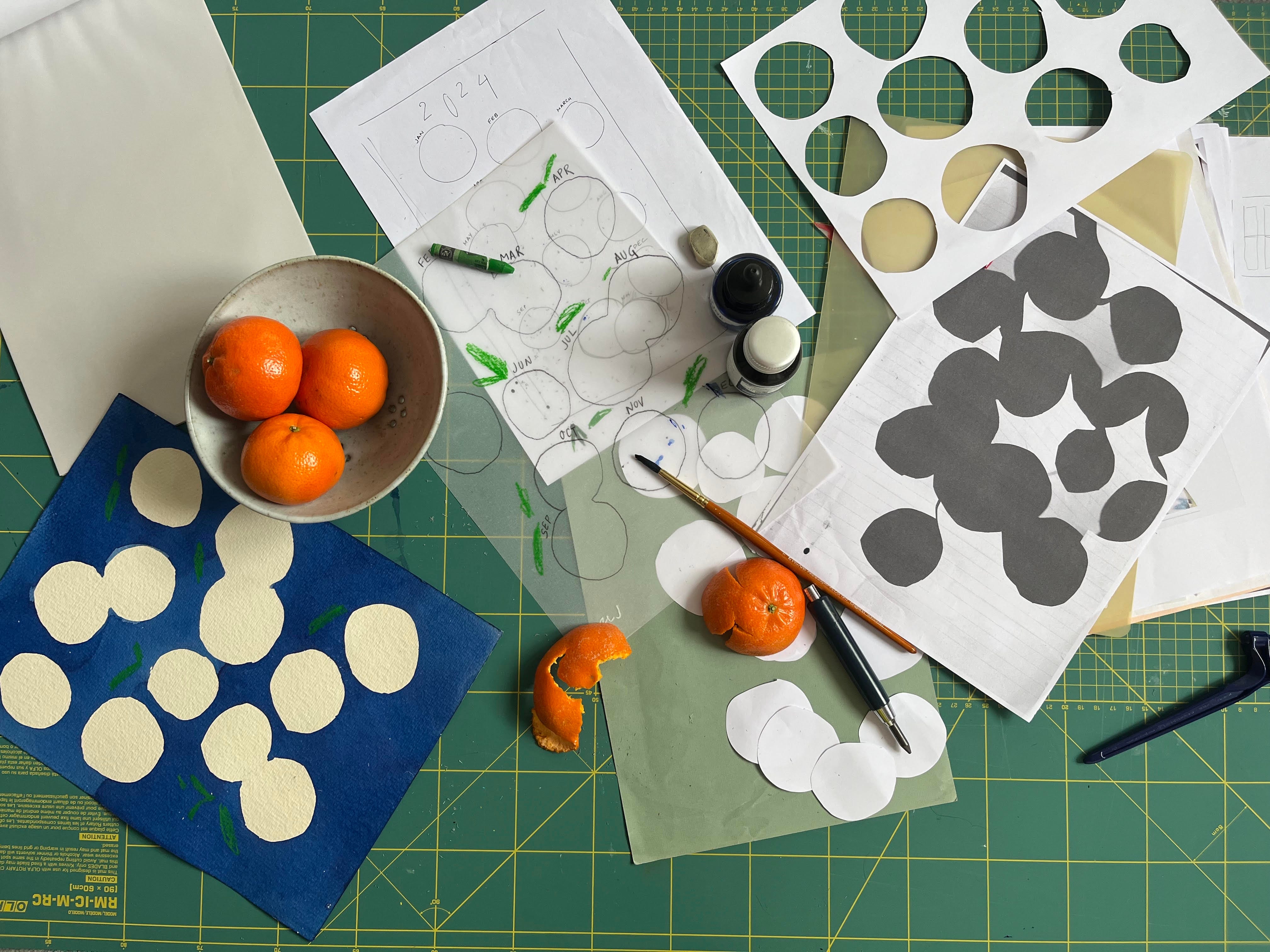
Roxana: Oranges have appeared throughout my work as a subconscious constant.
What other themes would you like to explore in your work?
Michelle: I started incorporating more storytelling into my personal work, which is evident alongside my poetic pieces. I like exploring themes of home and belonging, as well as the everyday. I would love to incorporate more relatable moments and real-life scenarios. I’d also love to add a bit more silliness.
Roxana: One way or another, I always come back to question the meaning of home. But, I would like to find a different thread for this quest of longing, perhaps by exploring topics such as the garden and cultivation.
What does home mean to you right now, and has that definition changed over time?
Michelle: Home, to me, is more than one place. I’m originally from Germany but have now lived in Ireland for nearly seven years. Home is where my family is, but also where I’ve built a life. I’m grateful that I can call Ireland and Germany both my homes, each in its own way.
Killian: As a third culture kid, my sense of home constantly changes. Right now, it’s wherever I feel I can be myself without pressure.
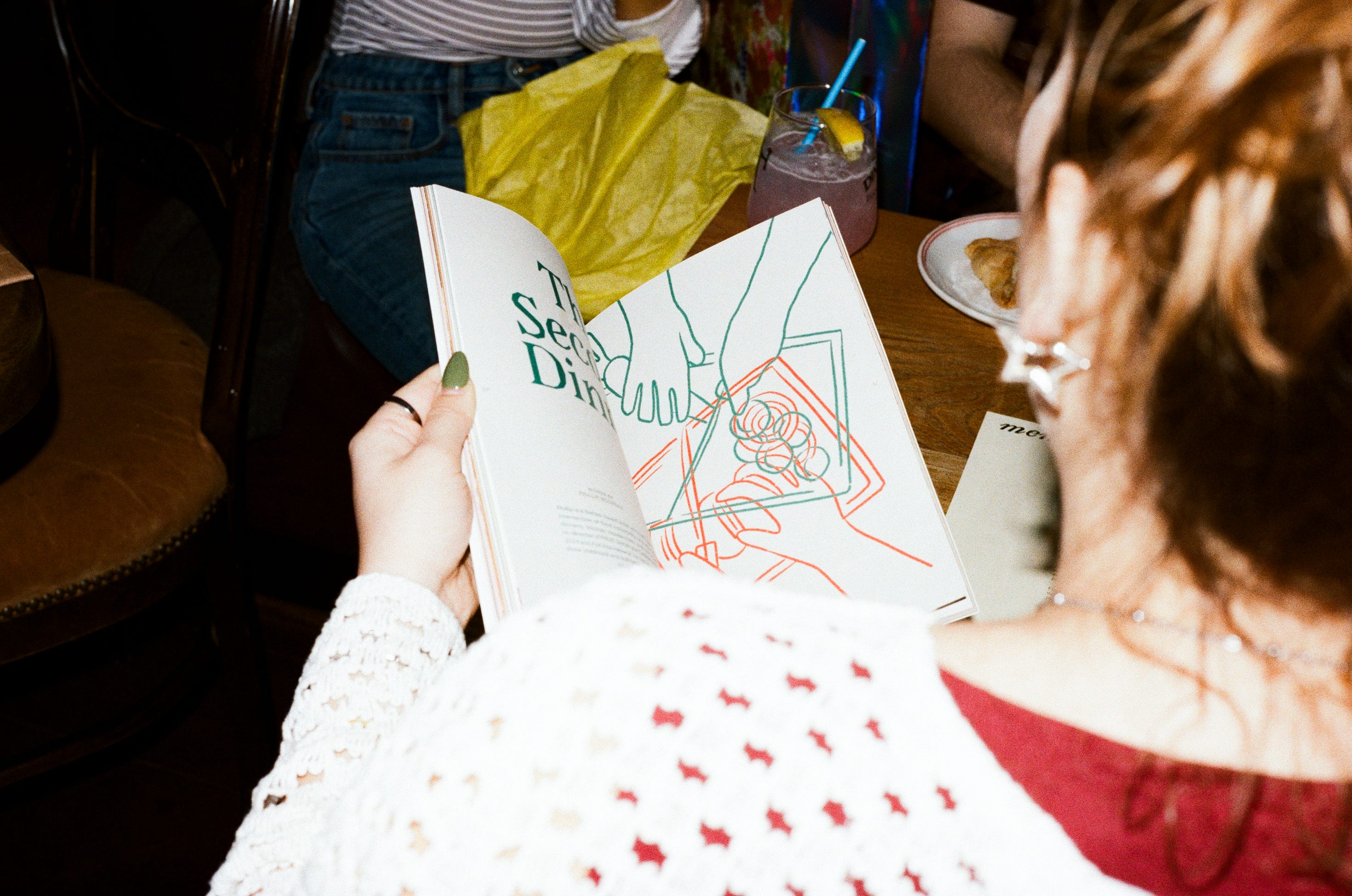
For issue three, we put forward the notion that home is more about memory than place. What does that idea bring up for you?
Michelle: I resonate with that a lot. I love the feeling of nostalgia when I’m thinking of my home in Germany. I get so excited about German week at Lidl, or about bringing over different types of bread to Ireland and eating them whenever I feel homesick.
Killian: Home signals safety; it might not be where you grew up. Maybe the home you’ve made is where you feel safe, but that idea of safety is what we nurture in our homes. We don’t want to stay at home, only to be reminded it’s there.
Roxana: I came to the conclusion that home is a moment in time, rather than a place. This means that it’s a fleeting feeling that I’m forever chasing.
Are there any recurring domestic objects or spaces that appear in your work?
Killian: My work is pretty connected with the outdoors. I like to zoom out to look at planets, zoom in to look at a garden from an ant’s perspective. I draw a lot of candles and chairs, but they’re rarely the focal point of the illustration.
Roxana: It’s the everyday objects that inspire me the most. Depicting what’s in front of me is an attempt to memorise it.
How does your physical working environment shape the mood or tone of your illustrations?
Michelle: I’m working as a designer. I feel that my work influences my illustrations in the way I deal with colour, composition, and texture. I also love bringing typography into my illustrative work, which is highly informed by my work as a designer.
Killian: I like my workspace and work to be a little chaotic. Often, seeing a bunch of unrelated images together sparks an idea for something new.
Is there a sense of nostalgia in your work, or do you try to avoid it?
Michelle: A lot of my work has an innate sense of nostalgia. I might not feel nostalgic when I illustrate it in the moment, but I feel it a few weeks later when looking at that piece again.
Killian: I love nostalgia because it’s like a preloaded set of symbols we all understand. It makes communication easier; you can quickly convey the idea of freedom with an image of someone diving into a pool.
Roxana: The very act of collaging, cutting out fragments and piecing them together, has nostalgia at its core.
How do you decide when an illustration feels finished?
Michelle: It’s a gut feeling, or the moment of ‘okay, this is enough’ — which can sometimes take between 10 minutes and 5 hours.
Killian: When there is nothing distracting me. If I’m not really focusing on any details, I move on. I’m not into overthinking; overworking ruins more pieces than naivety does.
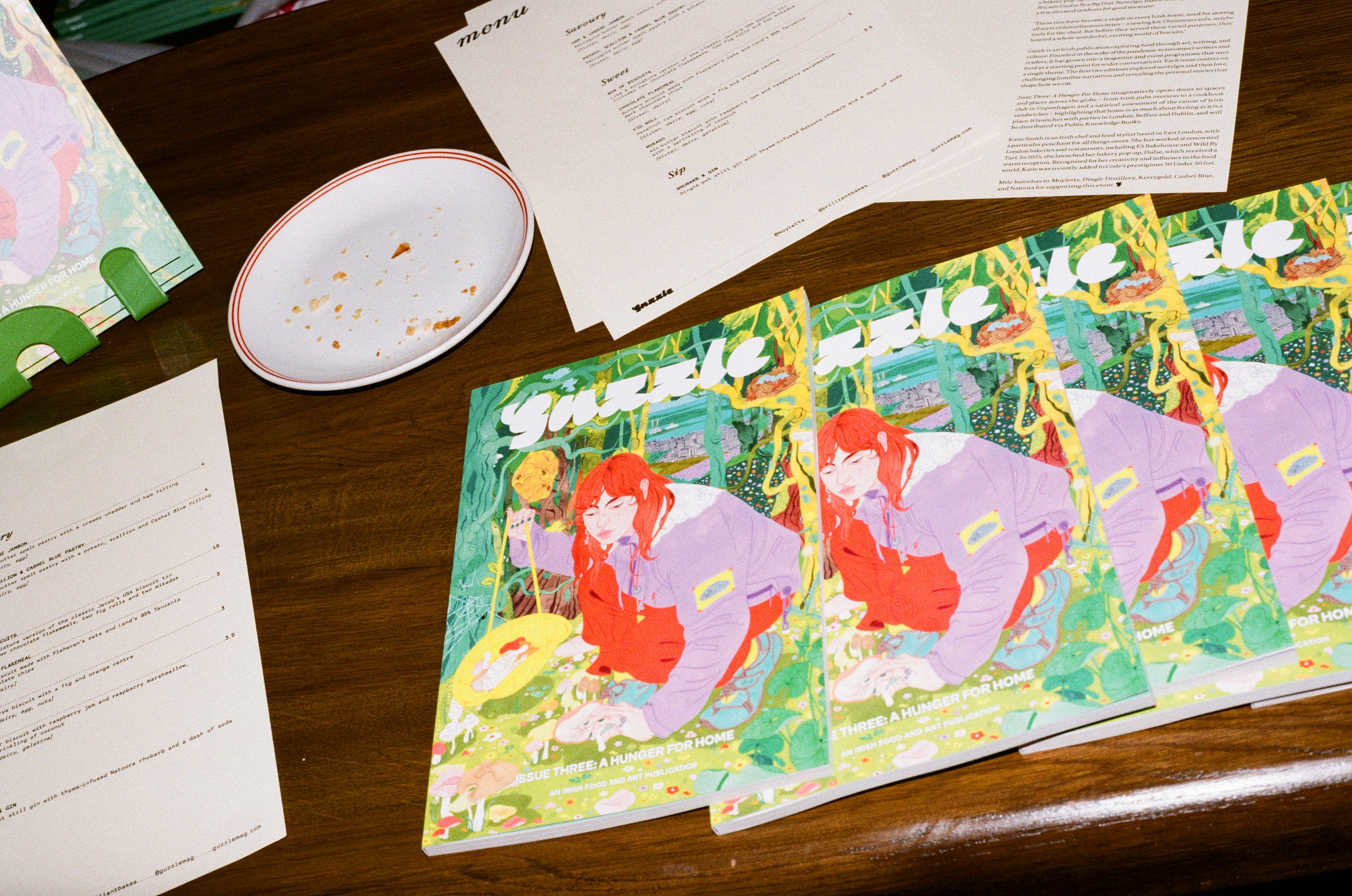
Issue Three: A Hunger for Home is available in various stockists in Ireland, the UK, and further afield. You can also pick up a copy from guzzlemag.com.